
Build Brand Recognition through Custom Christmas Cards

Now that Thanksgiving is over, Christmas is just around the corner. Have you thought about combining customer appreciation, brand awareness, and Christmas?

They fit together like a glove!

But why should you use valuable time and money to send cards and how do you go about it?

Keep on reading for some ideas that are sure to get your name noticed!

And you can use these ideas for personal use as well as business use, so read on!

1) Design and send Christmas cards because it improves customer retention. Your best customer is your existing customer! When you show that customer appreciation, you are encouraging them to turn into raving fans. That’s what you want! So that when you come up with a new product or service, they will be beating down your doors! A personal card with a unique design will communicate to them that you care. That you took the time to do something unique.

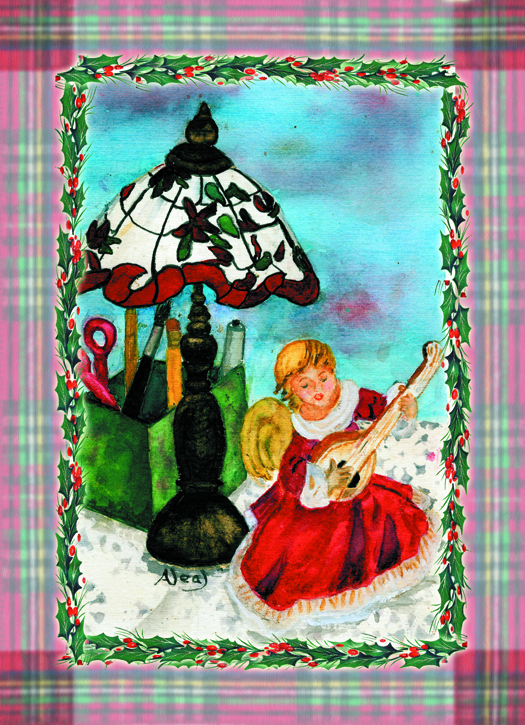
One of my clients (see card above, which I designed), an artist, has been doing Christmas cards for years. The people on her mailing list can’t wait to receive the card because they know it’s going to be something unusual. Now that’s name recognition!

2) Cards in the mail get noticed over email. Really! Think about it. What do you receive in your mailbox? Bills and junk mail, right? A card or letter is precious! The receiver of the card feels valued. E-mails are a dime a dozen and you are competing with many other e-mails. A spectacular card with your brand will automatically create name recognition and you will be on your way to creating raving fans!

3) But how can you create a spectacular card? With a scanner, some fabric, ribbon, and an original picture, you will have an unbeatable combination.

* Choose some fabric and ribbon, about letter page size. Make sure it’s not licensed!
* Scan it into computer at at least 300 dpi.
* Select an original piece of artwork, a photograph or painting. Scan it at 300 dpi.
* Layer the pieces together–use the fabric as a background, the ribbon as a frame, and the artwork as your centerpiece.
* Put your logo on the back with your address and website
* Include a personal greeting that complements your artwork

.4) Make your cards affordable by printing them through an online source. Overnightprints.com is my favorite source, and I have found them to be most cost-effective. They do great full-color work although the paper choice is limited. If you sign up for their mailing list, you will get great deals! Their cards come with white envelopes and they even have a mailing service!

5) If you want to choose semi-custom designs, Overnightprints.com has them available, or try Zazzle.com or CafePress.com. I plan to have some of my cards on these sites and will let you know as soon as I do!

6) If this sounds like too much work, hire a professional! I have been designing Christmas cards for years and would be glad to help you! But hurry, Christmas is around the corner and my schedule is already hectically busy! Just email me at info@angelarts.biz for more info.

Want more information on how to create your own Christmas cards? Introducing my new special report on 17 Steps to Creating Razzling Dazzling Christmas Cards! Features step by step easy to understand instructions, a webinar with a detailed tutorial, including demonstrations in software, and links to affordable resources for printing, inks, and print on demand sites.

And for a limited time I am offering it for sale! Grab your copy before Tuesday and you will get $50 off the retail price!

How to Make Brochures–Graphic Design Secrets that Will Make Your Brochure Sizzle!

So you’re thinking about making a brochure for your business. But how do you make brochures? And even more important, how do you make an effective brochure?

Basically, there are six stages of producing brochures:

  1. Initial Concept
  2. Writing
  3. Editing
  4. Designing
  5. Production
  6. Distribution

Fundamentally, brochures need to arouse attention and get interest. They need to motivate an audience toward an action.

You need to know your audience well. What is their age, location, income, family status, industry involved, job title/function, education level, political orientation, religious beliefs, ethnic origin?
Knowing all these things, think through what they really care about. What is important to them? What problems do they have? What are their fears, especially what are they afraid of losing?
Talk to your audience in terms of needs. What’s the problem? How can you meet that? Get benefits across to your audience. What solutions are you offering them?
Here’s some other ideas to help you create an effective brochure:

  • Use conversational tone “You”
  • Get message across in 20 seconds.
  • Make sure visuals work for you, that they illustrate a selling point.
  • Ask for action, make sure it’s easy to respond.
  • Use Business Reply Envelopes or include a custom domain name.

Additionally, ask these questions:

  • What is the purpose of your brochure?
  • Who is your audience?
  • What is your desired accomplishment?

Be sure to use graphic design elements:

  • Type
  • Graphics
  • Color of paper
  • Contrast and balance between dark and light
  • Balance between color and white space
  • Ink color
  • Contrast in type
  • Be consistent. This creates unity
  • Don’t use too much copy
  • Headlines are essential!

Follow these guidelines and you will have a brochure that sizzles!

Would you like to have a brand that sizzles and learn the principles of print design? Check out my free mini video course at Make Your Brand Sizzle.

Want even more help in turning your brand into quality print design? Get step by step guidance through my online tutorial course at Brand Identity Quest.

Print design ideas—So is print design obsolete?

In this age of Internet marketing, you may be wondering, is print design dead? Well, let me ask you these questions?

What role did, if any, will print design play in the 2012 election?
How does print design help businesses? Churches? Charities? Artists?
But with everything going “green” why even care? Why is it important?

Here’s my opinion as a graphic artist for over 17 years:

Print design is timeless. There is something about holding paper that is so much more enjoyable and has a different effect than just an ebook or website or film.

What are some examples of where you see print design?

  • Direct marketing
  • Product design
  • CD/DVD packaging
  • Books
  • Newsletters/magazines
  • Greeting cards

Think about it. When it’s your birthday, would you rather receive an email or a card in the mail?

Even when a product is an ebook, like curriculum, there is still design to it. Or there can be to distinguish yourself above most ebooks out there, all created in Microsoft Word.

Think about Web designers. Some Web designers might be good at writing HTML code, but know nothing about design principles. Then there are web designers who know nothing about code!

Professional design stands out above the crowd, especially in these days when EVERYBODY thinks they are a graphic designer!

When you learn how to create unique designs that stand out and scream professionalism, you become more successful at reaching whatever your goal is for that project. It’s the difference between a professionally designed website and a canned website.

Or a professionally designed brochure and a brochure made from a template. It’s also the difference between having a bland brand and a brand that SIZZLES!

Would you like to have a brand that sizzles and learn the principles of print design? Check out my free mini video course at Make Your Brand Sizzle.

Want even more help in turning your brand into quality print design? Get step by step guidance through my online tutorial course at Brand Identity Quest.

OLD BOOKS
© Mietitore | Dreamstime.com